_edited_edited.png)
"Build your school's own behaviour and wellbeing expertise, with expert guidance alongside you"
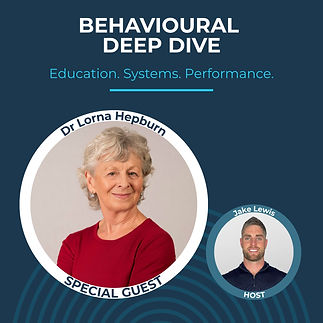
Implementing Multi-Tiered System of Supports in Schools - Dr. Lorna Hepburn
In this episode, I sit down with Dr Lorna Hepburn to explore what it takes to successfully implement a Multi-Tiered System of Support (MTSS) in schools.
Drawing on her extensive experience supporting schools across Australia, Lorna unpacks the leadership, systems and implementation practices that underpin effective Tier 1 supports. Together, we discuss why schools adopt MTSS, the role of data-based decision making, common misconceptions and "lethal mutations" that can derail implementation, and how schools can begin building effective Tier 2 systems.
Whether you're a school leader, educator or behaviour consultant, this episode offers practical guidance for building sustainable, evidence-based systems that improve outcomes for all students.
Show Notes
Why schools adopt a Multi-Tiered System of Support (MTSS)
The episode begins by exploring why schools choose to implement a Multi-Tiered System of Support (MTSS) and the challenges they are often trying to solve.
Drawing on her own journey from classroom teacher to system leader, Lorna reflects on the limitations of trying to improve outcomes one student or one teacher at a time. Instead, she explains why lasting change comes from building systems that support every educator and every student.
The conversation also explores how schools often begin their MTSS journey through behaviour or literacy before recognising that academic, behavioural and wellbeing outcomes are deeply interconnected and are best supported through an integrated framework.
What MTSS is (and what it isn't)
A major theme throughout the episode is developing a shared understanding of what a Multi-Tiered System of Support actually is.
Lorna explains that MTSS is not a behaviour program, a collection of interventions or simply another initiative for schools to implement. Rather, it is an organisational framework that helps schools organise evidence-informed practices so that every student receives the right support at the right time.
The discussion also clarifies the terminology commonly used across education; including MTSS, School-Wide Positive Behaviour Support (SWPBS), PBIS and Positive Behaviour for Learning (PBL) and explains how these frameworks relate to one another.
What effective Tier 1 implemention looks like
The episode explores what effective Tier 1 implementation actually looks like in practice.
Lorna describes schools where expectations are explicitly taught, routines are predictable, positive behaviour is acknowledged, behavioural errors are addressed instructionally, and classrooms provide consistent learning environments for all students.
The conversation also explores the critical systems that support successful Tier 1 implementation, including leadership, implementation teams, explicit teaching, behaviour-specific feedback, consistent responses to behaviour and creating conditions that make effective practice easier for staff to implement.
Leadership, teams and data-based decision making
The discussion then shifts from classroom practice to the systems that underpin successful implementation.
Lorna explains why strong leadership, representative implementation teams and effective meeting structures are essential for sustaining MTSS over time. Rather than relying on intuition or isolated incidents, schools are encouraged to use data to identify patterns, prioritise improvement efforts and evaluate whether the supports they are providing are making a meaningful difference.
Particular attention is given to using the "Big Five" questions to move from broad concerns about behaviour towards precise problem-solving that informs prevention, teaching and reinforcement.
Common misconceptions and "lethal mutations"
The episode also explores several common misconceptions surrounding MTSS and School-Wide Positive Behaviour Support.
Lorna discusses why MTSS is often mistakenly viewed as a reward system, a behaviour management program or a short-term initiative, and explains why these misunderstandings can undermine implementation.
The conversation also introduces the concept of "lethal mutations", which are adaptations that preserve the appearance of a framework while removing the critical features that make it effective. Examples discussed include displaying school values and expectations without explicitly teaching them, relying on behaviour ladders and step systems that focus on escalating consequences rather than instruction, and using response strategies such as time out without considering the function of behaviour or embedding opportunities to reteach the expected behaviour.
Throughout the discussion, Lorna reinforces that successful implementation relies on explicitly teaching behavioural expectations, responding to behavioural errors instructionally, and building systems that consistently support positive behaviour across the school.
Tier 2 Supports: Moving beyond Tier 1
The episode concludes by exploring Tier 2 supports and why they are often described as the "forgotten middle child" of MTSS.
Lorna explains how schools can identify students requiring additional support, match students to evidence-informed interventions and monitor progress using clear decision rules. The discussion reinforces that Tier 2 is far more than a collection of programs, it requires the same systems, data processes and implementation structures that underpin effective Tier 1 practice.
.
Resources
-
Hepburn, L. (2026). Implementing school-wide positive behaviour support: A practitioner's guide to Tier 1. Routledge.
-
Association for Positive Behaviour Support Australia - Facebook Page and Blog
-
Center on PBIS (Positive Behavioural Interventions and Supports)
-
McIntosh, K., & Goodman, S. (2016). Integrated multi-tiered systems of support: Blending RTI and PBIS. Guilford Press.
Contact Dr. Lorna Hepburn
Dr Lorna Hepburn is the founder of The Behaviour Coach and a recognised leader in the implementation of School-Wide Positive Behaviour Support and Multi-Tiered Systems of Support. With experience as a teacher, school leader, behaviour adviser and system leader, she spent more than a decade leading SWPBS implementation across government schools in Queensland. Lorna also serves on the steering committee of the Association of Positive Behaviour Support Australia (APBSA), is the author of Implementing School-Wide Positive Behaviour Support: A Practitioner's Guide to Tier 1, and continues to support schools across Australia to build sustainable, evidence-based systems that improve outcomes for all students.
