_edited_edited.png)
"Build your school's own behaviour and wellbeing expertise, with expert guidance alongside you"
The Behavioural Deep Dive
Behavioural Deep Dive brings together conversations with leading experts to explore how behaviour science can be applied to learning, systems, and performance.
With a strong focus on real-world practice, the podcast aims to bridge the gap between research and application, supporting educators and those working in complex environments to better understand behaviour and create conditions for success.

01
Introduction
In this debut episode, host Jake Lewis introduces the Behavioural Deep Dive, a podcast exploring the systems and habits that drive high performance in schools, teams, and organisations. Jake makes the case that the most effective teams aren't just the hardest working, but the best designed, and outlines his mission to bridge behaviour science research with practical, real-world strategies.
02
Function-Based Thinking in Schools -Dr. Russ Fox
In this episode, host Jake Lewis sits down with Dr. Russ Fox, lecturer in Applied Behaviour Analysis at Monash University and former teacher, school leader, and policy advisor, to explore the power of function-based thinking in education. Russ unpacks what it really means to understand why students behave the way they do, moving beyond labels like "naughty" or "disruptive" to look at the environments, skills, and histories that shape behaviour. This conversation offers educators a practical framework for knowing their students more deeply and responding with both compassion and clarity.

03

Student Motivation and Acknowledgement Systems -
Jennifer Payne
In this episode, I sit down with Jennifer Payne, teacher, psychologist, and Director of Rypple, to explore student motivation, acknowledgement systems, and some of the common misconceptions surrounding rewards in schools. Jennifer unpacks intrinsic and extrinsic motivation, discusses self determination theory, and reframes acknowledgement systems as tools for behavioural skill development, positive feedback, and data informed decision making within schools.
04
Three High-Leverage Classroom Practices for Student Success-
Dr. Adam Feinberg
Which classroom practices provide the strongest foundation for student success? Dr Adam Feinberg joins the podcast to explore how clear expectations, effective routines, and behaviour-specific feedback create the conditions for learning while supporting positive behaviour, engagement, and wellbeing. We discuss why these practices are foundational components of effective Tier 1 support and how educators can strengthen their implementation to create predictable, supportive learning environments.
For show notes and resources, click here.

05

Trauma-Informed Practice in Schools
- Dr Erin Leif
In this episode, I sit down with Dr Erin Leif to explore trauma and trauma-informed practice within schools. We discuss how adversity can influence learning, behaviour, and relationships, the protective role schools can play, and some of the common misconceptions surrounding trauma-informed practice.
Throughout the conversation, Erin highlights how many of the principles of trauma-informed practice align closely with effective Tier 1 supports within a Multi-Tiered System of Support, providing practical insights for educators seeking to create safe, predictable, and inclusive learning environments for all students.
06
Implementing Multi-Tiered System of Supports- Dr Lorna Hepburn
In this episode, I sit down with Dr Lorna Hepburn to explore what it takes to successfully implement a Multi-Tiered System of Support (MTSS) within schools. We discuss why schools adopt an MTSS framework, the critical features of effective Tier 1 implementation, the role of leadership and data-based decision making, and some of the common misconceptions that can derail implementation.
Throughout the conversation, Lorna emphasises that MTSS is far more than a collection of programs or interventions. Instead, she highlights the importance of building sustainable systems that support effective practice, highlighting the concept of "lethal mutations" in implementation and sharing practical insights into creating positive, predictable learning environments where all students can succeed.

07

School Attendance is Everybody's Business
- Dr Lisa McKay-Brown
School attendance is one of the most significant challenges currently facing schools, yet supporting students to attend consistently requires far more than monitoring absences. Associate Professor Lisa McKay-Brown explores the different types of school attendance problems, how educators can recognise the early warning signs of school avoidance, and why understanding the reasons behind non-attendance is essential to providing effective support.
Throughout the conversation, Lisa explains how schools can apply a Multi-Tiered System of Support to attendance, highlighting the importance of early identification, evidence-informed intervention, strong partnerships with families, and viewing attendance as a whole-school responsibility.
08
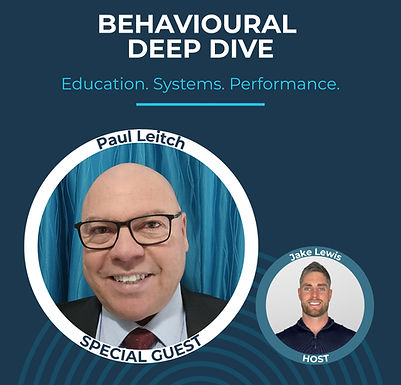
Preventing and Responding to Escalating Behaviour - Paul Leitch
In this episode, I sit down with Paul Leitch to explore practical, evidence-informed approaches to preventing and responding to behavioural escalation in schools. We discuss why effective de-escalation begins long before a student reaches crisis, the importance of productive classroom environments, and how educators can use the escalation cycle to guide their responses as behaviour changes.
Drawing on more than 35 years of experience supporting schools, Paul shares how calm, purposeful responses, proactive classroom practices and a strong instructional focus can reduce escalation while keeping students engaged in learning. The episode is packed with practical strategies that teachers and school leaders can immediately apply to create safer, calmer and more productive learning environments.
09

The Doing is the Learning: Opportunities to Respond - Karina Stocker
Opportunities to Respond are often viewed as a strategy for increasing student engagement, but their role in effective instruction extends much further. Karina Stocker explores how OTRs provide students with repeated opportunities to practise academic and behavioural skills, receive feedback, and strengthen learning.
Throughout the conversation, Karina explores what effective OTRs look like in practice, including group and individual responding, differentiation, error correction, and how student responses can provide ongoing information to guide instructional decisions.